Recently, I had to review a film for my composition class. I wanted to pick a film that actually got me thinking and entertained dark, thrilling elements. With halloween coming up, I thought–what better movie to pick than our favorite businessman killer, our American psycho?
American Psycho (2000), was directed by Mary Harron and based on a top-selling novel written by Bret Easton Ellis in 1991. This film is about a young, sophisticated businessman–Patrick Bateman–living in New York in the late 80’s. However, he’s an uncontrollable and horrendous serial killer when nighttime hits. The film has running themes of self-identity, isolation, illusion and insanity, all of which contribute to its dark, horrific elements.
Self-identity and distortion are recurring themes in this film. Patrick seems to be living as two identities. We first have his social identity: businessman, agreeably uninteresting and undistinguishable from his co-workers. Then there’s his psychotic, night-time, killer identity that has no remorse. Because he’s one person, understanding which identity he is at certain points in the film can seem confusing. Cinematography works as a guide for the audience to see which “person” he is.
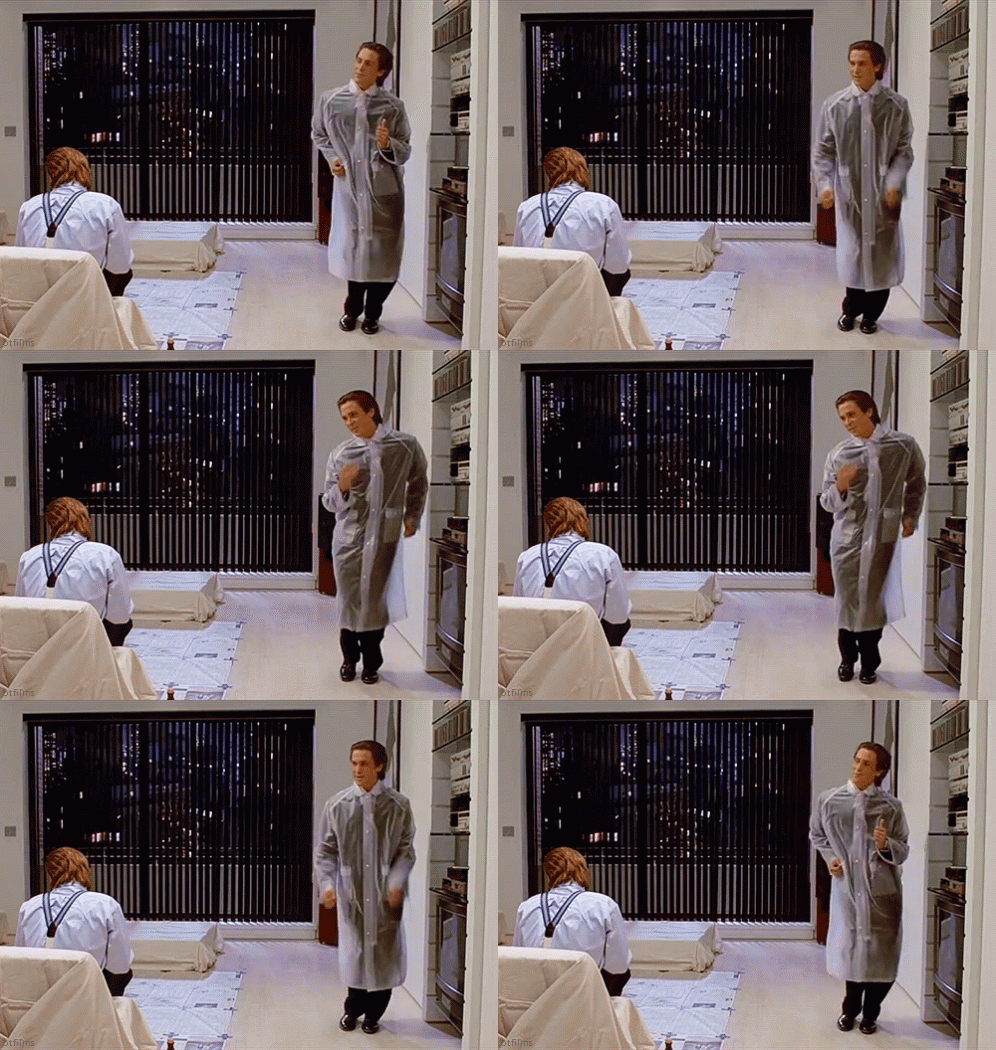
For example, the consistent shots of Bateman’s reflection in mirrors shows that he’s aware of his other identity. He wears Valentino business suits as a symbol of his social identity. While he’s murdering his co-worker, Paul Allen, he puts on a transparent raincoat, veiling the view of his pristine business suit. This represents his social personality being blocked, or pushed aside as his murderous, malicious side steps forward.
There is a shot of the ‘Les Mis’ French flag casted over Bateman’s face. This shot is exactly half-lit; one side of his face is perfectly illuminated, the other cast with a dark shadow. This can be seen as a symbol of his bipolar, dual nature with one side, bright and charming while the other, villainous side hides in the darkness.
The concept of masks as a symbol consistently shows up in Bateman’s life. In his opening monologue, he applies a face mask and slowly peels it off. This represents how he “puts on a mask” before he goes out into the world and interacts with people–his evil side is hiding under his social identity. Then there are scenes where Bateman’s face is covered with blood, looking as if it is a mask; this is representative of his evil persona blocking, or masking his sane, social identity. He is constantly masking his true identity to match whatever situation he’s in.
If a tree falls in a forest when no one is there, does it make a sound?
This philosophy can be specified in context to: if you confess to murdering forty people and nobody believes you, does it even matter? The lack of self identity is displayed in Bateman’s social interactions with his peers and fiance. His coworkers seem confusedly interchangeable to one another.
“There is an idea of a Patrick Bateman, some kind of abstraction. But there is no real me. Only an entity. Something illusory,” Bateman declares.
But no one appears to care. Worse yet, no one even notices. Bateman confesses to these peers multiple times to the murders he committed. Each person either laughs it off or pretends not to hear, giving way to the storm of frustration and insanity heightening in his narrative.
Bateman’s hysterical confession to his lawyer on the phone is quite possibly the loudest shout for help he could give.
“Howard, it’s Bateman. Patrick Bateman. You’re my lawyer, so I think you should know I’ve killed a lot of people.”
He goes on to confess, in detail, to every murder he committed. In response, his lawyer simply laughs, mistakes him for a different client and praises him on pulling “such a funny joke on that loser Patrick Bateman.” The lack of distinguishability between the individual worth or traits of the characters in their uptight, high-class society is what drives Bateman to become a murderer. In his world of isolation and no discernible identity, murder is his insanity-driven way to differentiate himself from the rest.
Lastly, as an audience, it’s vital to unpack the idea of a false narrative, or being misled through the actual timeline of events. Distortion, insanity, self-identity are all themes that heavily rely on the musings and broken gears of Patrick Bateman’s mind. This leaves us with the question: were all of his murders just a product of his mind as well? Did he just imagine each kill and leave the audience to believe it actually happened?

During the movie, there are a few compelling examples that serve as evidence for this false narrative. For example, after Bateman’s killing spree, he visits the apartment in which he stored the “evidence” of his murders. This is when everything we understood to be true of Bateman’s narrative starts to unwind. The evidence is completely wiped from the apartment; painted over without a trace. He runs into a realtor; she states that nobody named “Paul Allen” actually lived there. Near the end of the film, Patrick is told by his lawyer that he couldn’t have committed the murder of Allen, because he went out to dinner with a different coworker, Paul Owen, the prior week.
Essentially, American Psycho has elements of isolation, insanity, and self-identity that seem to falsely lead the audience through an incorrect timeline of events told by a bipolar, psychotic narrator. These elements also serve to satirize the upper-working class of late-80’s New York “yuppies”, so to speak. Although the perplexing plot line has led people to argue about its truth, the original author, Ellis, has said that the greatness of the story is exactly that we do not know whether or not Bateman committed the crimes.
As an audience, we’re left to wonder if the his insanity led us through a false, blurry narrative, or if he recounted everything exactly as it happened, but no one cared.





 LED light bulbs: one bright idea
  Walking instead of driving
 Go vegetarian!
 Pick one cup and stick to it
 Do it ONLINE
 Words by Emily